


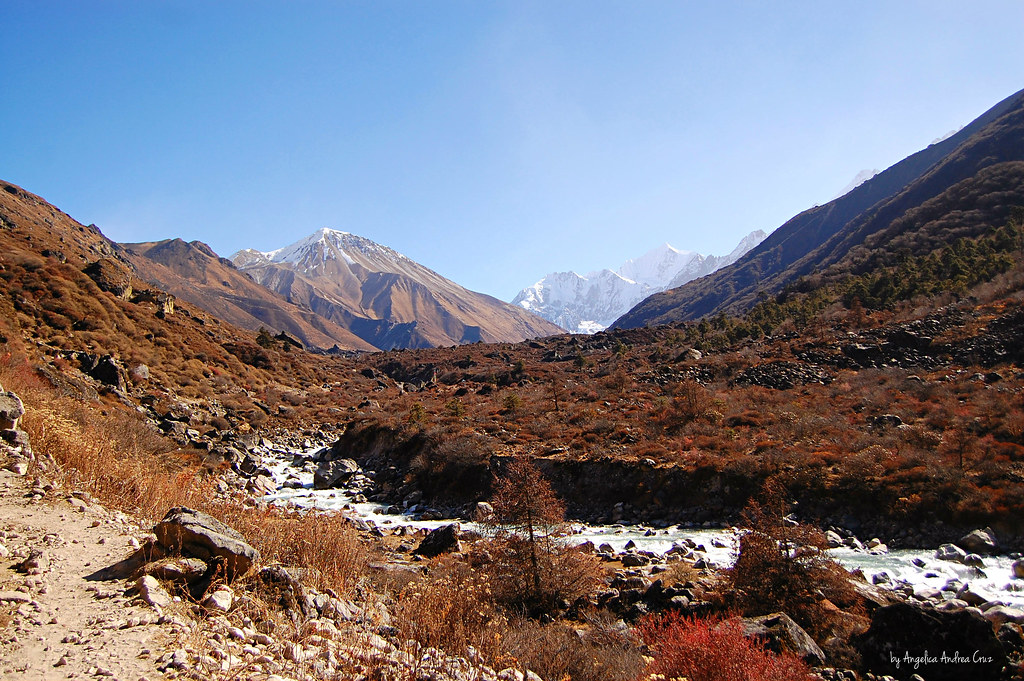
beautiful landscape and peaks of the Langtang region
AN UNPLANNED TRIP
A denied visa application had me thinking of an alternative trip since I already had a flight out of Manila. And Nepal was on the top of the list. I only had a two-week leave so the trekking options were limited. It was only between going back to Annapurna (I did Annapurna Sanctuary back in 2011) or the Langtang Valley. I emailed Katie, a friend I met during the Annapurna trek, to ask about tips and trek details on Langtang. The first thing she told me was not to do it alone (in all caps, and she made me promise). She loves the trek and the region but unfortunately, over the last three years, 2 solo female trekkers have been found dead and one is still missing. A photo of the girl is still posted on one of the military posts on the trail. This even caused the government to impose a no-guide-no-trekking policy in Nepal in the latter of 2012, but it didn’t push through. (READ: But all other trekking regions are considered safe for solo independent female trekkers). I didn’t know if I was willing to pay extra for a guide, or if I wanted to trek with a guide. I just bought the ticket which was on sale and decided that I’ll figure it all out when I get to Nepal.
I stayed in Hotel Red Planet, the same hotel we had back in 2011, because of the cheap rooms and the really nice family that owns it. I felt really happy when they recognized me and asked if I’ve been there before. They took care of me again and assisted in all of my trekking queries. I asked if there were other people in the hotel who were planning to go to Langtang. But most of them were headed to the more famous regions of Annapurna and Everest. I didn't have enough time to go looking for a group to trek with so I asked if she can recommend a trekking company.
COST : TREKKING WITH A GUIDE
The next day I met the owner of the trekking company who was really nice and very familiar with the region. We talked about a 9-day itinerary for the Langtang Valley Trek, including the 2 days transfers to/from Syabrubesi which is the take-off point for the trek. I was quoted USD500 for the whole trek including a guide, food, accommodations, fees, and transportation.
Below was my initial budget for a 9-day trek with a total of around USD250-300:
1) Daily cost - USD20-25
2) TIMS – USD20, Langtang Conservation Fee – USD30
3) Transportation – USD20-30
A guide’s rate is normally USD25-30 per day. With this, the fee quoted seemed reasonable. To appease my friends and family, I knew paying an extra USD200 would be worth it. Before finalizing everything, he introduced me to his son who will be my guide. I asked him questions about Langtang and his trekking experiences. He was a nice guy, only 24-years-old but had done various treks in Langtang, Annapurna, Everest, and Manaslu regions. But I think it was more because of his father that I finally booked the trek with them.
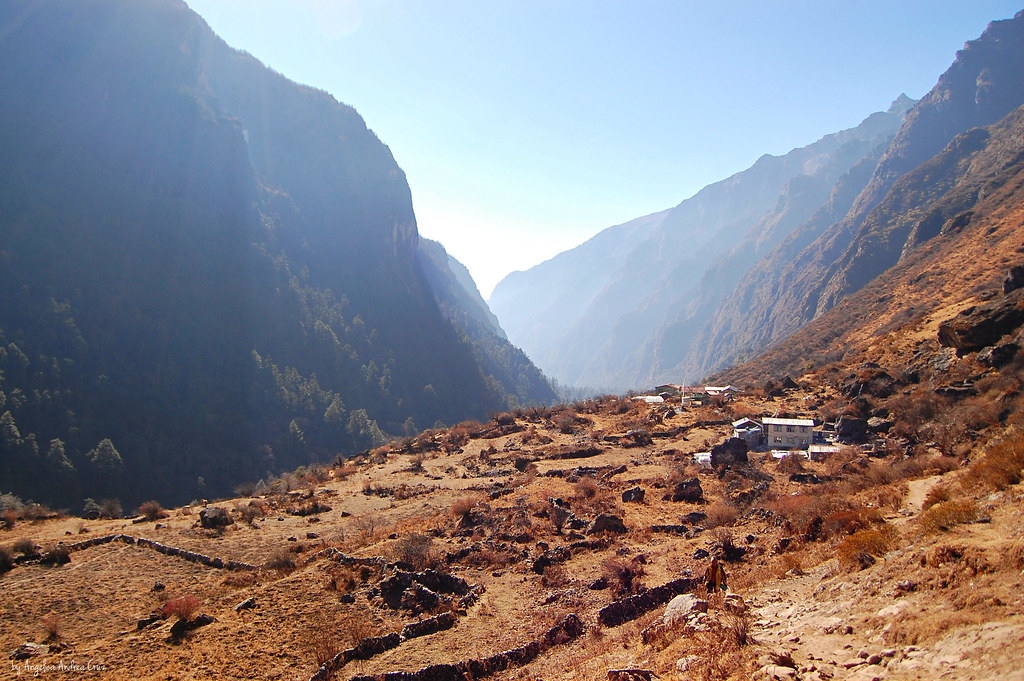
Trekking in Langtang during winter, with clear blue skies and dry stunning landscape
LANGTANG VALLEY
The Langtang region lies 130 km north of Kathmandu and is close to the border with Tibet. Unlike Annapurna and Everest, the region sees fewer trekkers. Another highlight of the trek to this region is the chance to see and observe the unique culture of the Tamang people. Several Himalayan peaks can be seen in the trek, along with glaciers and lakes.
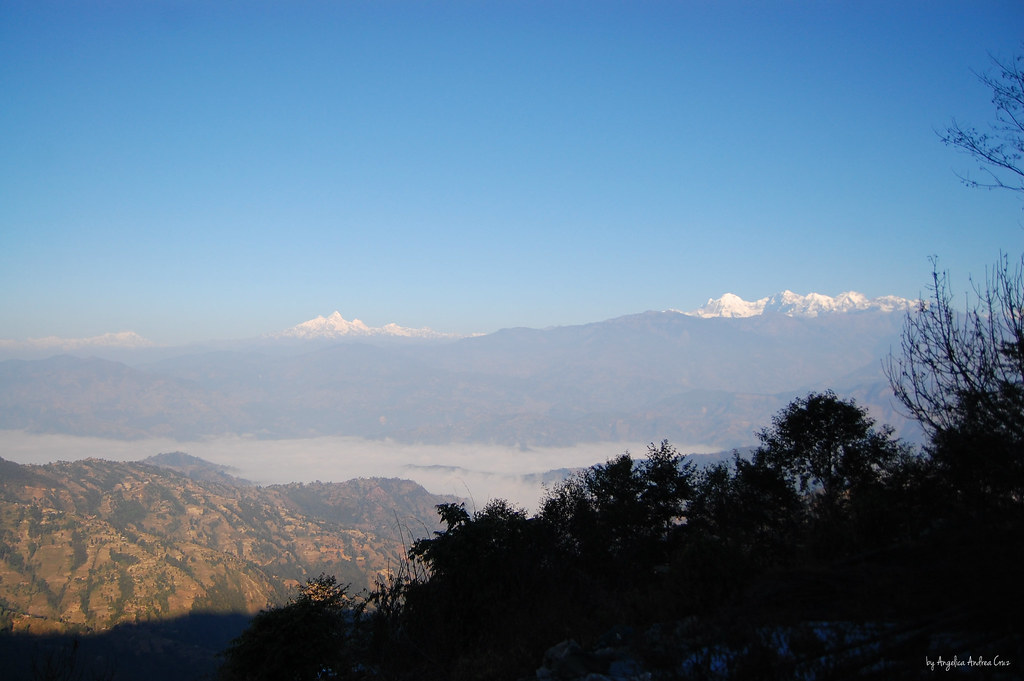 Langtang peaks, view during the bus ride from Kathmandu to Syabrubesi
Day 1 : Kathmandu to Syabrubesi (1470 m)
The next day we rode a mini-bus going to Syabrubesi. I’ve heard and read a lot of people complain about this bus ride. Most people can’t figure out why it takes 10 hours to cover 130 kilometers, and because of the scary cliff-side road going there.
The bus ride wasn’t as bad as I expected. It took only 7 hours and it would have probably been less if not for the many military checkpoints we had to stop at. But the road was definitely scary. Most of the time it seemed like a one-way road, with vehicles having to stop and reverse to let the incoming pass, or honking loudly before turning a curve. There were also landslide areas as we got nearer our destination. But our young bus driver seemed like an expert and was very calm during the whole ride. But it was the scenic view that relaxed me. Low-lying clouds engulfed the valley below, and the different Himalayan Langtang peaks can already be seen throughout the ride.
Syabrubesi was just a small cluster of houses, hotels, and shops. Nestled between two mountains, the sun only hits it late in the morning until around 4pm. It was cold up there. At the garden of our hotel, some of the guests and owners were laying on the grass and moving almost every hour following the sun.
Day 2 : Syabrubesi (1470m) to Lama Hotel (2480 m)
This was the start of our trek in and it was the hardest for me. Unlike the more developed Annapurna region where the trail is made up of steps, the trail in Langtang is made up of uneven stones and small boulders. The trail was dusty, making some of the stones and boulders quite slippery. A few hours into the trek and as we were starting to make our 1000 meters ascent for the day, I realized how heavy my bag was, like I haven’t learned my lesson yet during the Annapurna trek.
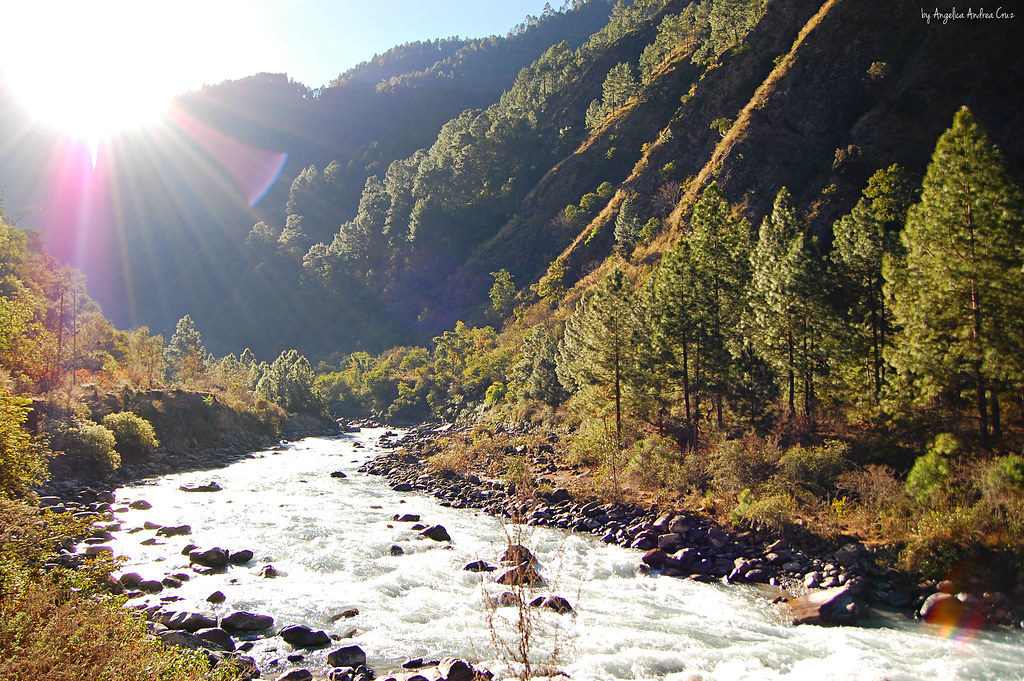 i love Himalayan mornings like :)
The trail goes deeper into the mountains, following the river of Langtang Khola. For almost half of the day, the sun never hits the trail, making the trek really cold.
 lunch by the river in Bamboo
We stopped in the village of Bamboo for lunch, with the river beside it and a view of some of the Himalayan peaks. The rest of the day was hiking steep trails and spotting snow monkeys in the forest, until we made it to Lama Hotel where we spent the night.
Day 3 : Lama Hotel (2480 m) to Langtang (3430 m)
I was so tired the previous day that I slept right away. I decided to leave some things, including my pack of cigarettes, in the hotel in Lama then pick it up again on our way back to Syabrubesi. It was an easier day, I had a lighter bag and the trail was a gradual ascent. But I still took my time since it was another 1000m ascent, but this time to an elevation where symptoms of altitude mountain sickness start to occur.
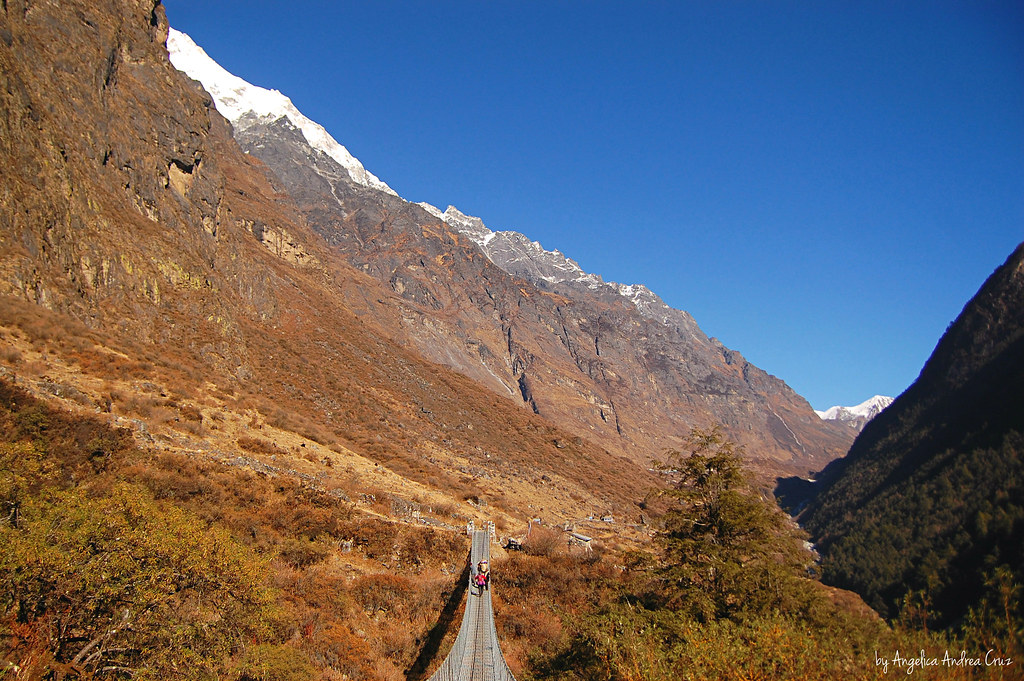
The landscape was different. Vegetation was sparse and the trail opened up to a wide area of dry and deserted grassland, with big black rocks scattered around. Yaks were also seen along the trail. My guide told me that the landscape and culture are similar to the Everest region. We also encountered the Tamang people with their yaks going up to Langtang village.

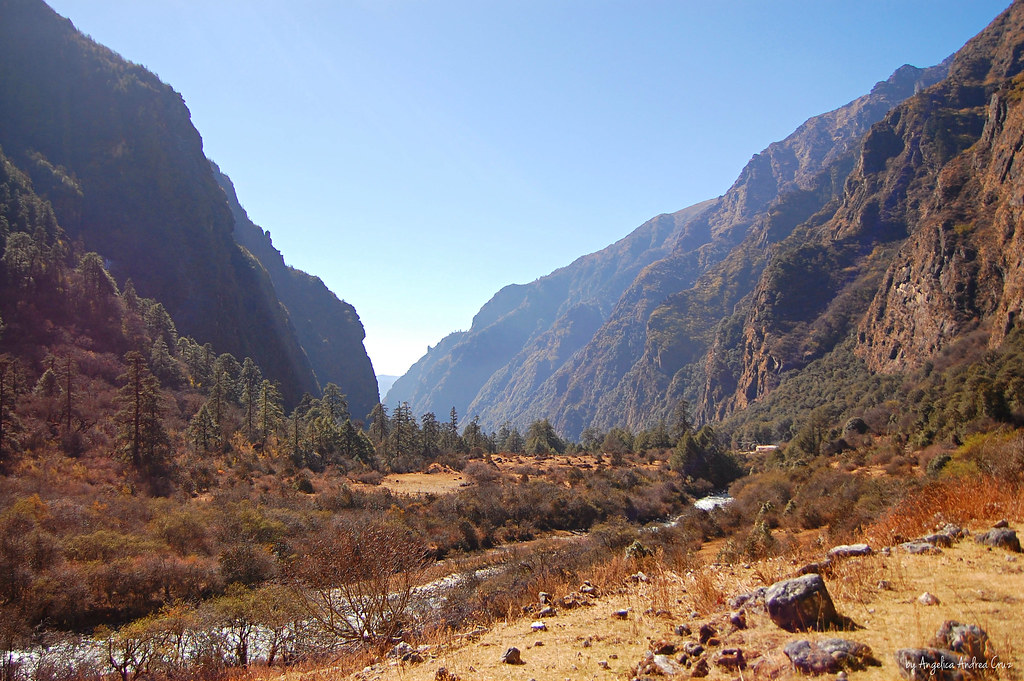
 lunch at Ghora Tabela
We stopped in Ghora Tabela for lunch. From this village, one can see the stunning view of some of the Langtang peaks.
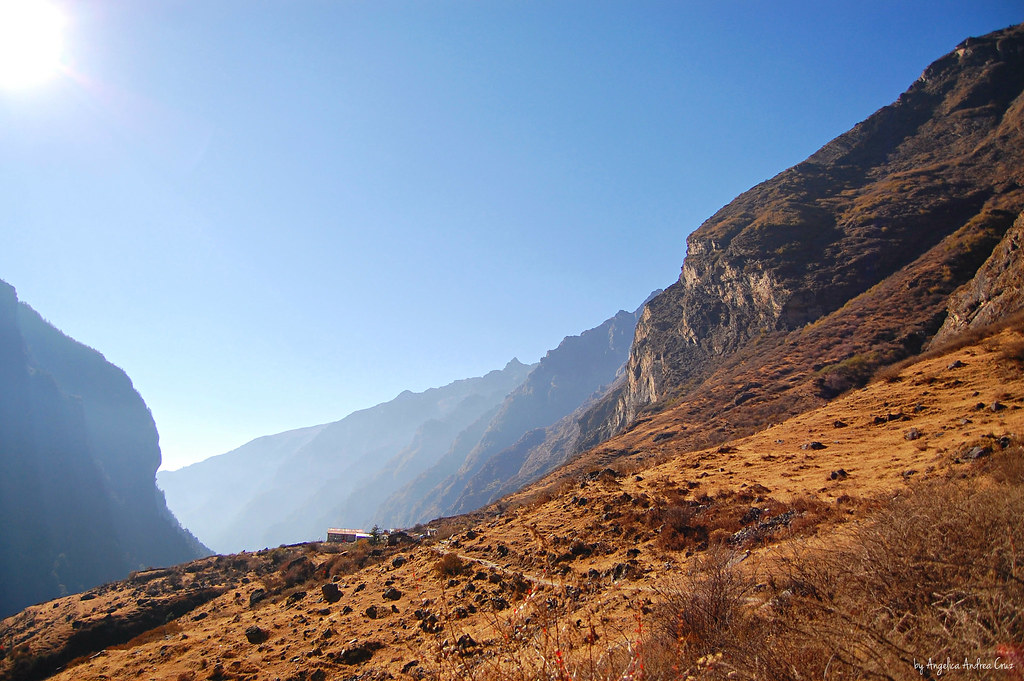 loved looking back to this view during breaks
The trail after that got more scenic, with the peaks of Tsergo Ri and Gang Chhenpo slowly presenting themselves.
 Tsergo Ri at 4984 m (left) and Gang Chhenpo at 6387 m (right)
We ended the day at Langtang village. This time my guide decided to stay at a hotel where there were other trekkers to meet. It was true what my friend Katie said – there are far less trekkers in the Langtang region, even more since it was the winter season. Because of this, I got closer to the other trekkers/guides/porters more because there were only a few of us on the trail. I met two Dutch women, a Spaniard who told me great stories about South America, a family from Malaysia who understood how uncomfortable the cold was because we're Asians (haha), and two French guys who were on a gap year. And there were also the guides and porters who were funny and very helpful. At night, we’d all be in the dining area and I’ll find them seated around the heater, and it never fails that they reserve or offer a chair for me. This camaraderie shared by everyone in the trek is one of the things I love about teahouse trekking in Nepal.
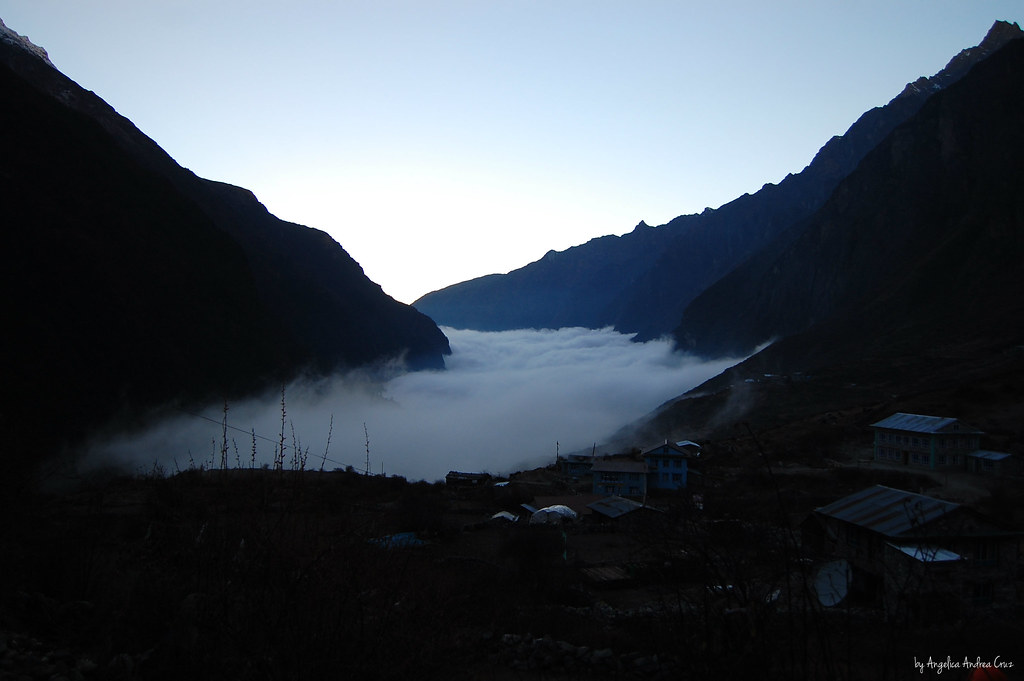 thick fog slowly engulfing Langtang village right after sunset
Day 4 : Langtang (3430 m) to Kyanjing Gompa (3860 m)
Sleeping in Langtang village wasn’t that easy, it was quite a struggle keeping warm even with my -5C sleeping bag. But I was excited to start walking again to reach Kyanjing Gompa. It was a freezing glorious morning. We passed by frozen puddles of water on our way out the village, but the snow-capped mountains were a sight to behold.
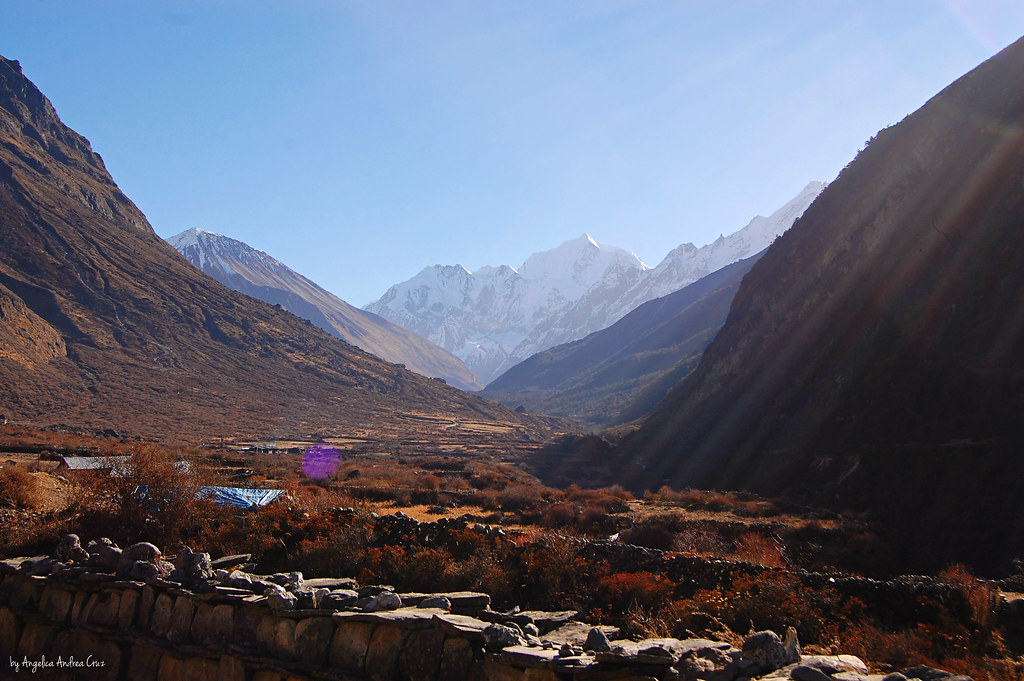 beautiful morning in Langtang village
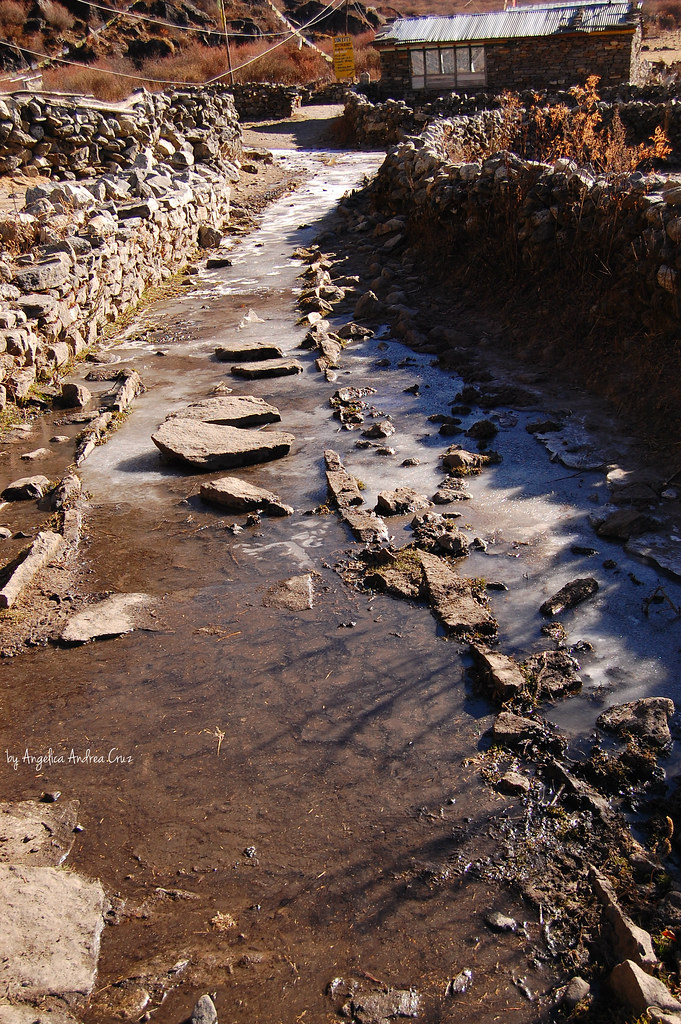 frozen puddles of water
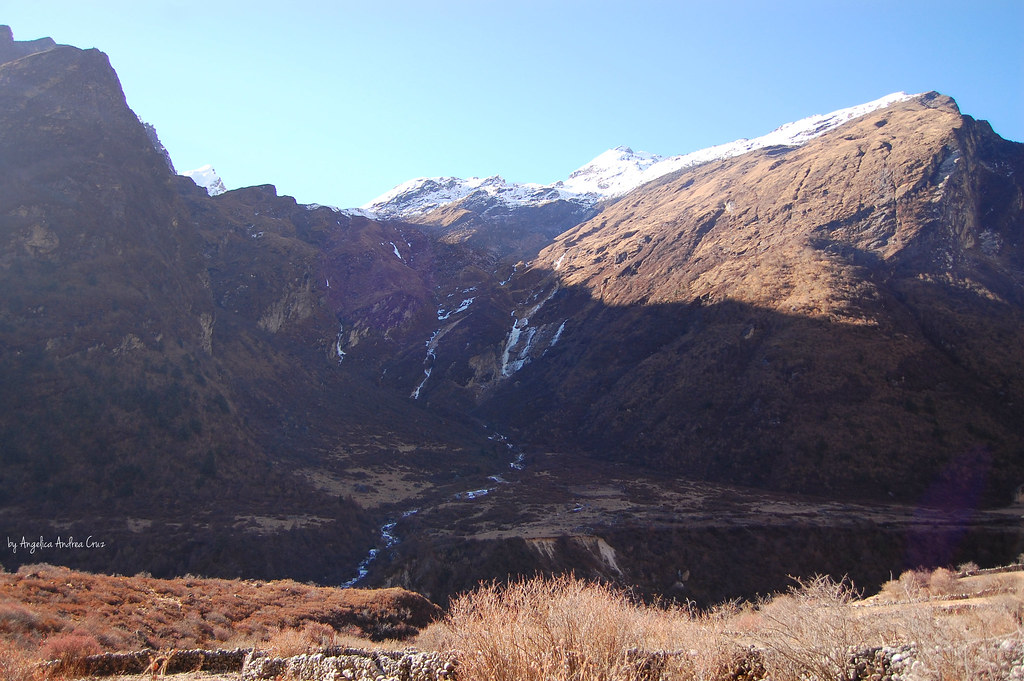 frozen waterfalls as the sun never hits this part of the mountain
Small walls of mani stones, carved with Tibetan mantras, lined our path going to Kyanjing Gompa. Tibetan Buddhist stupas with prayer flags can also be seen on different parts of the trail.
 walls of mani stones outlined the path
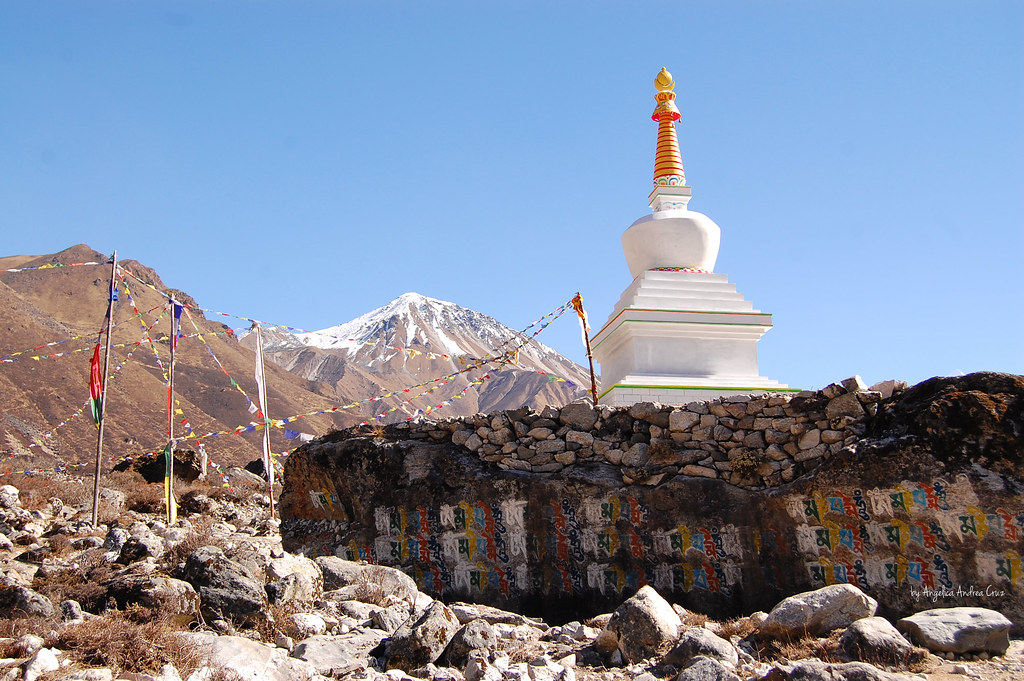 Tibetan Buddhist stupas can be found along the trail
The small teahouses along the way were closed for the winter giving the trek that morning a desolate feeling. The cold wind was harsh, but the surrounding Himalayan peaks were pushing me. On our left, one of the glaciers in Langtang can be seen. On our right were snow-capped Himalayan peaks. And right in front of us was a fuller view of Tsergo Ri.
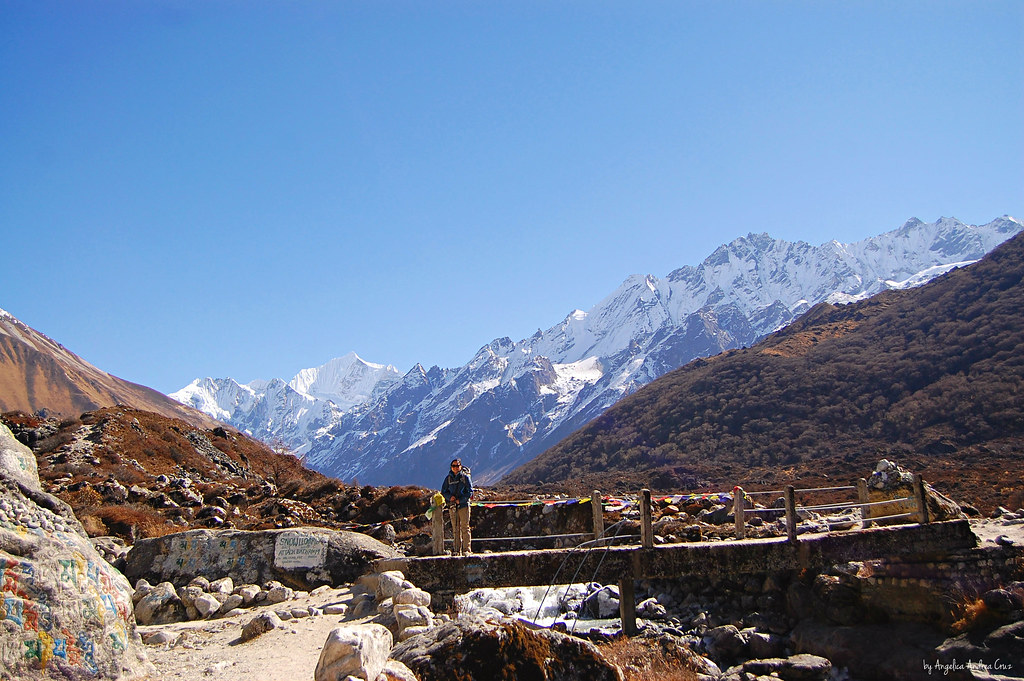
getting nearer Kyanjing Gompa
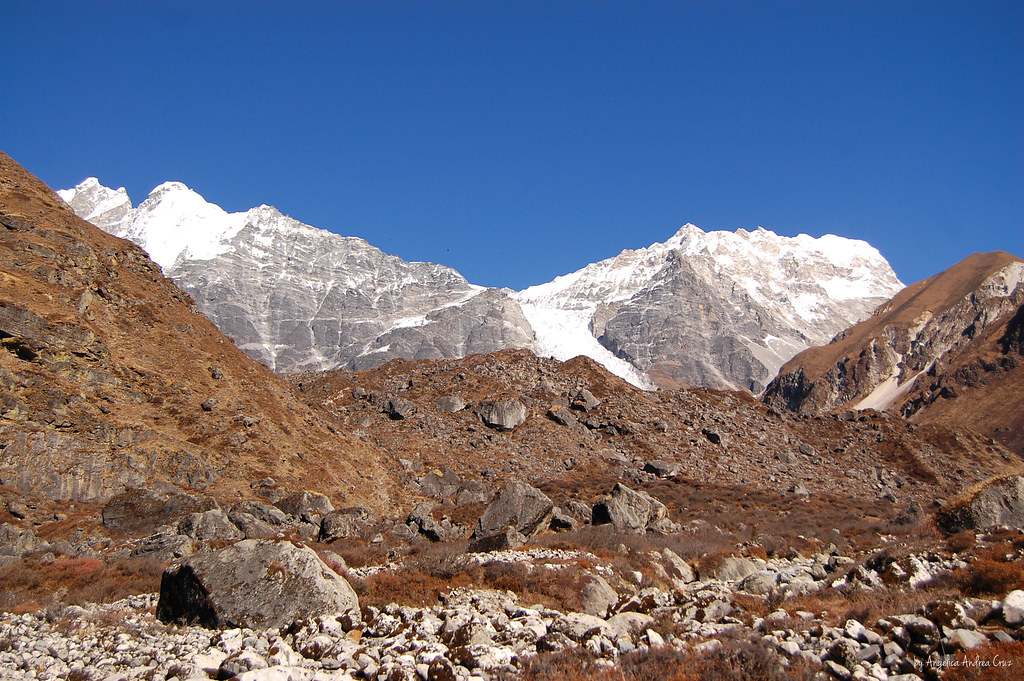
one of the glaciers in Langtang
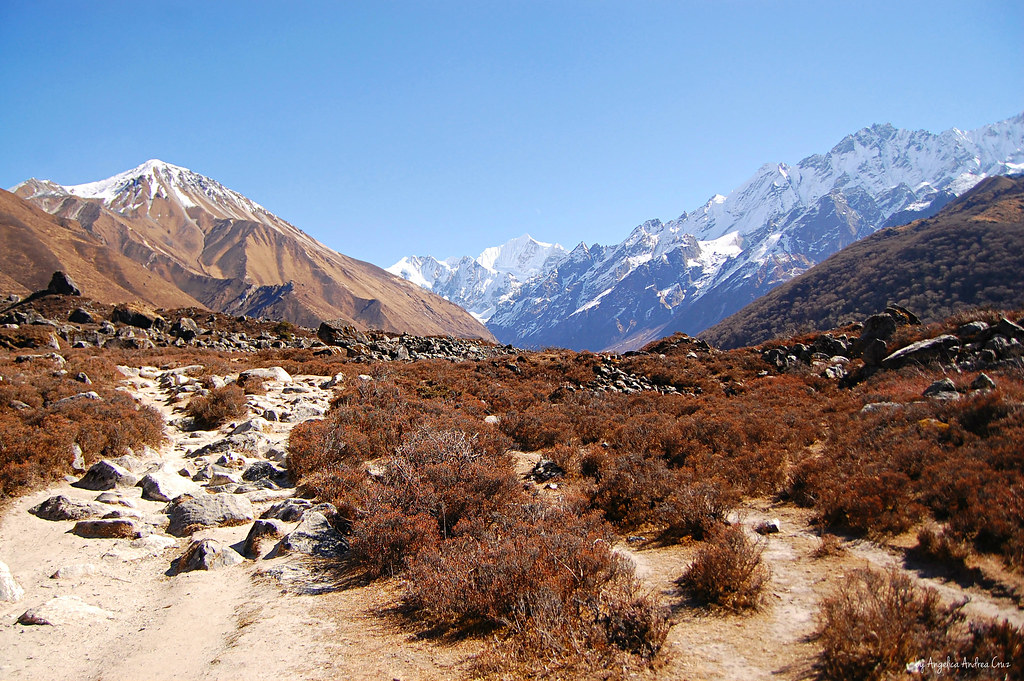
We arrived in Kyanjing Gompa right before lunch. At 3860 m, the village sits on a valley surrounded by Himalayan peaks and glaciers.
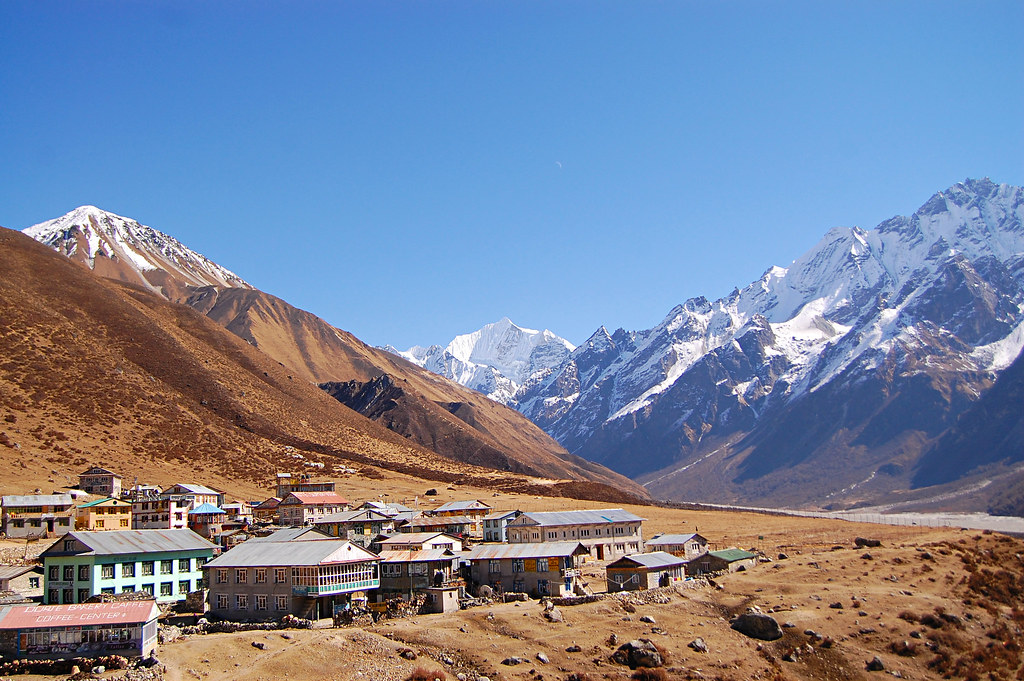 Kyanjing Gompa at 3860 m
Eating lunch was quite a struggle for me but I knew I had to finish it. I knew my body needed all the energy it can get to last a day in the village. I could feel my lungs and heart making extra effort to keep my body to function properly. To acclimatize, I decided to walk around the village.
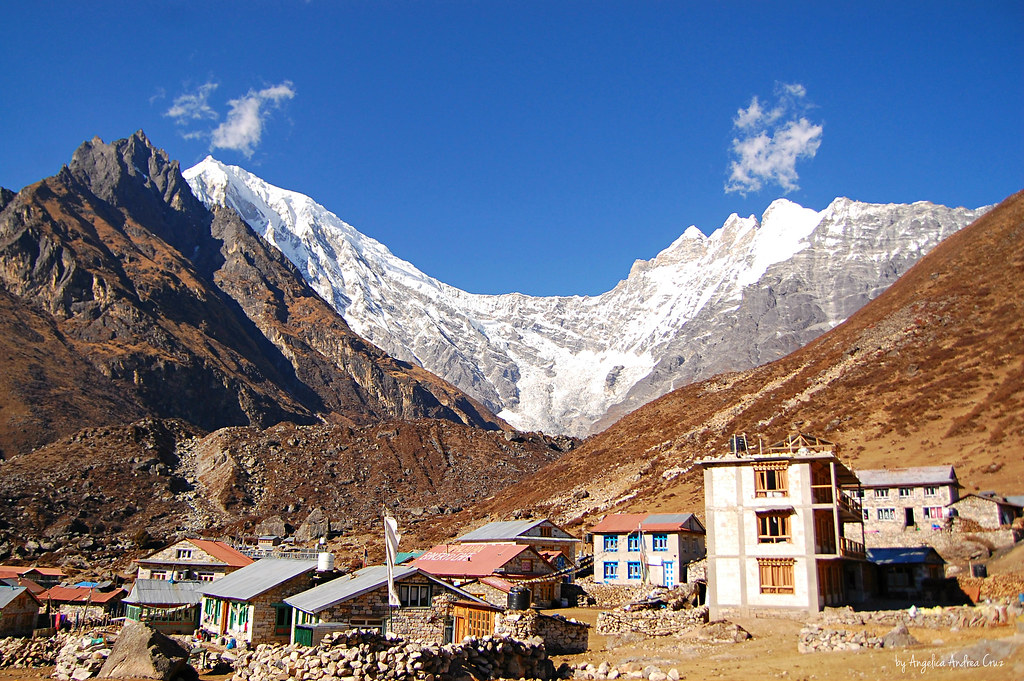
I passed by different teahouses until I found a wide open space where I saw the mountains closer. It was a little after noon and the sun was shining bright, and the blue sky so clear. Wind was picking up from time to time, but the weather was perfect. And I don’t know, I just felt so happy that time. I wrote about it here.
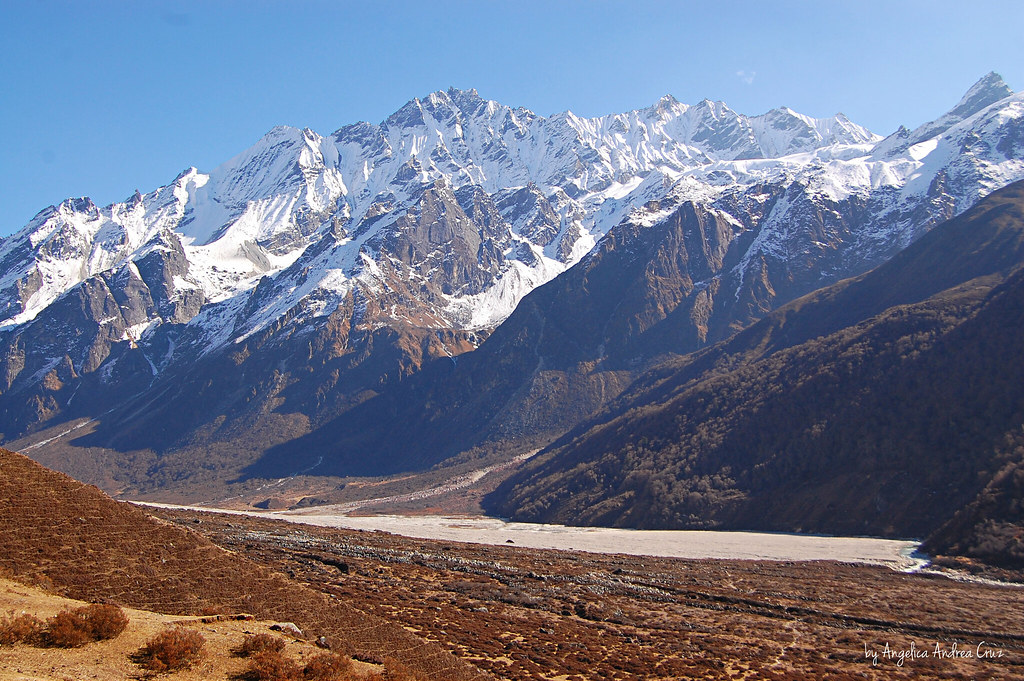 sat near the edge of the valley to enjoy this view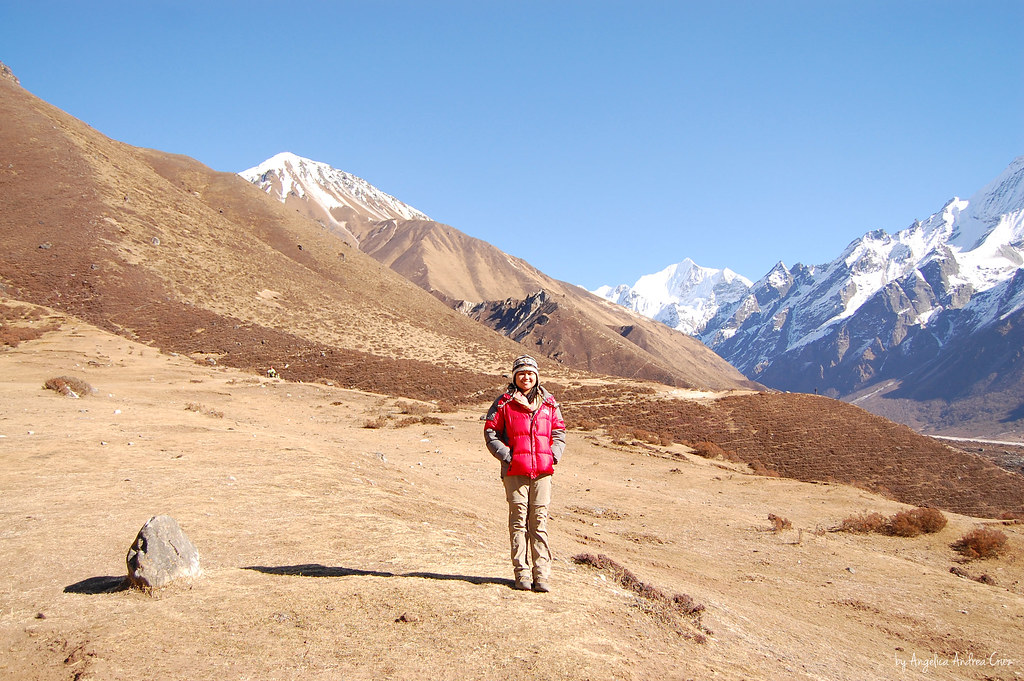
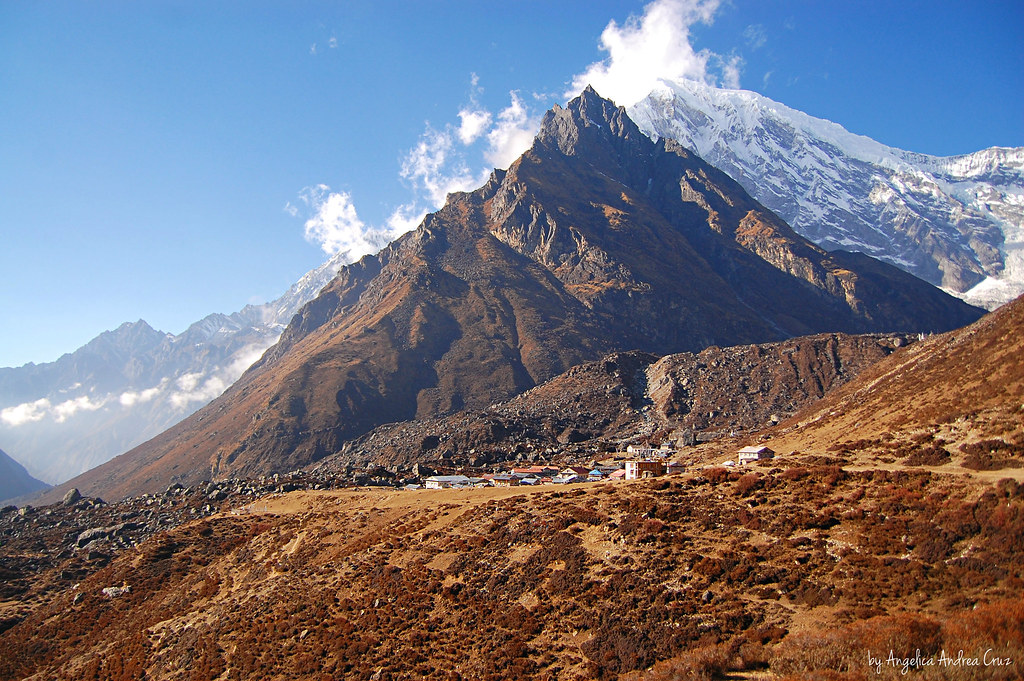 Kyanjing Gompa towered over by Lantang Lirung (7227 m), with its peak partly-covered by clouds
I went back to our hotel and hanged out with the other trekkers, guides and porters. We played cards and talked about the short climbs we could do the next day. There are two mountain peaks in Kyanjing Gompa that can be climbed without mountaineering gear/experience. There’s Kyanjing Ri at 4600m and Tsergo Ri at 4984m. You can also go down to the glaciers, which I regret not doing because the French had really cool photos from that place. In my itinerary, I was supposed to and I really wanted to hike Tsergo Ri. But my guide said that it wouldn’t be advisable since there was already snow on the peak. The Spaniard went up Kyanjing Ri that afternoon and said that it wasn’t that hard except for the slight headache he had going down. This made him decide to not climb Tsergo Ri anymore. The French decided to climb Tsergo Ri and in their running shoes, they’re a funny duo and definitely risk-takers.
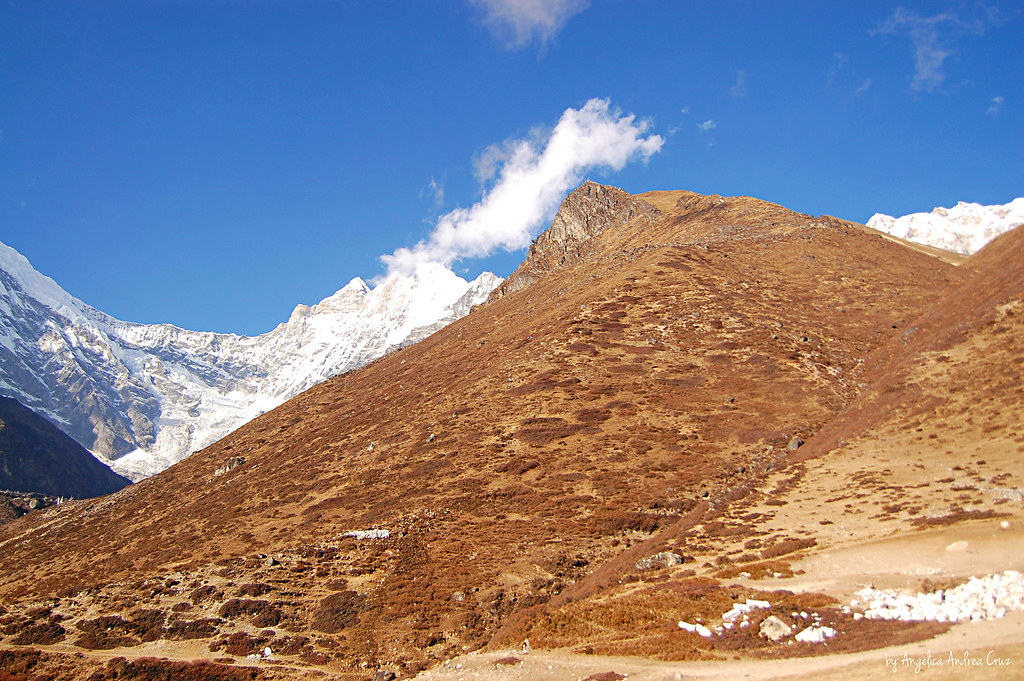 the steep climb to the top of Kyanjing Ri
Day 5 : Kyanjing Ri to Lama Hotel
It was another sleepless night, because it was freezing and it was a little bit hard to breathe. I slept at 10pm and woke up past 11pm to the sound of foil being rustled. I turned on my headlamp and saw that a portion of the chocolate bar in the side pocket of my bag was eaten by a rat. This went on until 3am when the rat decided to leave my room. I only had four hours of sleep in total and the next day I saw that the rat also ate a portion of the yak cheese I bought. Damn rat, didn’t know they existed even in high elevation.
With only four hours of sleep, we started our climb up to Kyanjing Ri (a 700m steep ascent) at around 7am with one of the Dutch women and their guide. It was quite a challenge going up, more because of the cold and the thin air. The trail was very narrow and quite slippery since parts of it were loose soil. It didn’t help that we saw a rescue helicopter flying in and out of Kyanjing Gompa to the higher parts of the snow-capped mountains. We learned afterwards that some trekkers had to be rescued from the high pass due to altitude sickness.
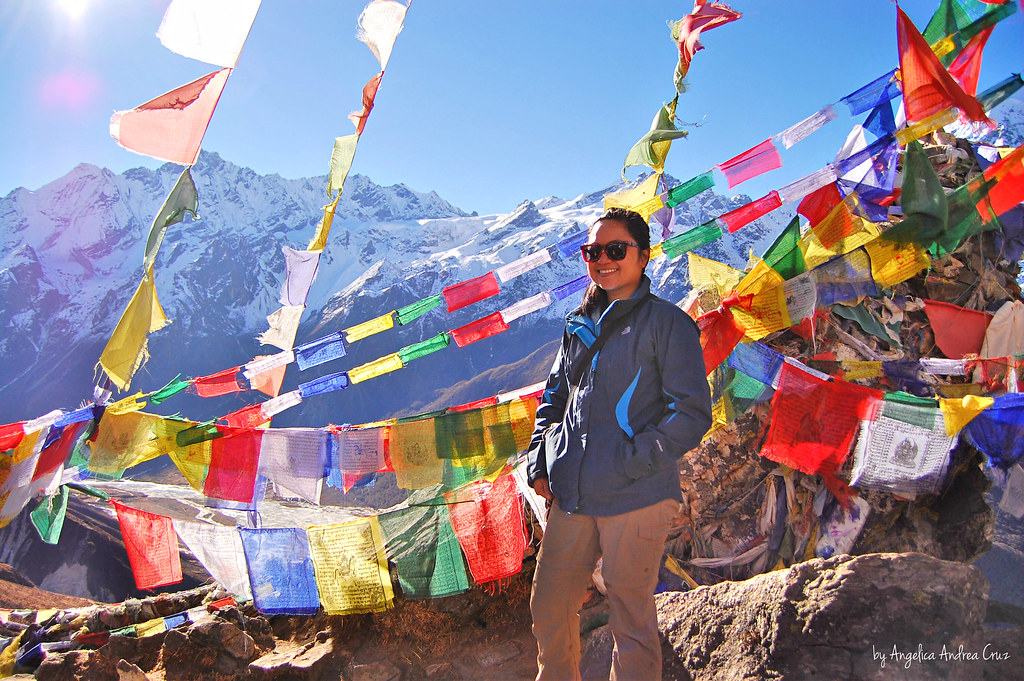
After almost 2 hours, we finally made it to the peak. Colorful Tibetan prayer flags covered it. From there was a great view of Langtang Lirung, Kimshung, the glacier, the Tibetan side of the Himalayas, frozen lakes, and the mountain range of snow-capped Himalayan peaks. I saw another trail we can climb closer to the Tibetan side, but my guide said that it was Yala Peak. We felt so happy and accomplished for making it to Kyanjing Ri. I honestly didn’t think I’d make it.
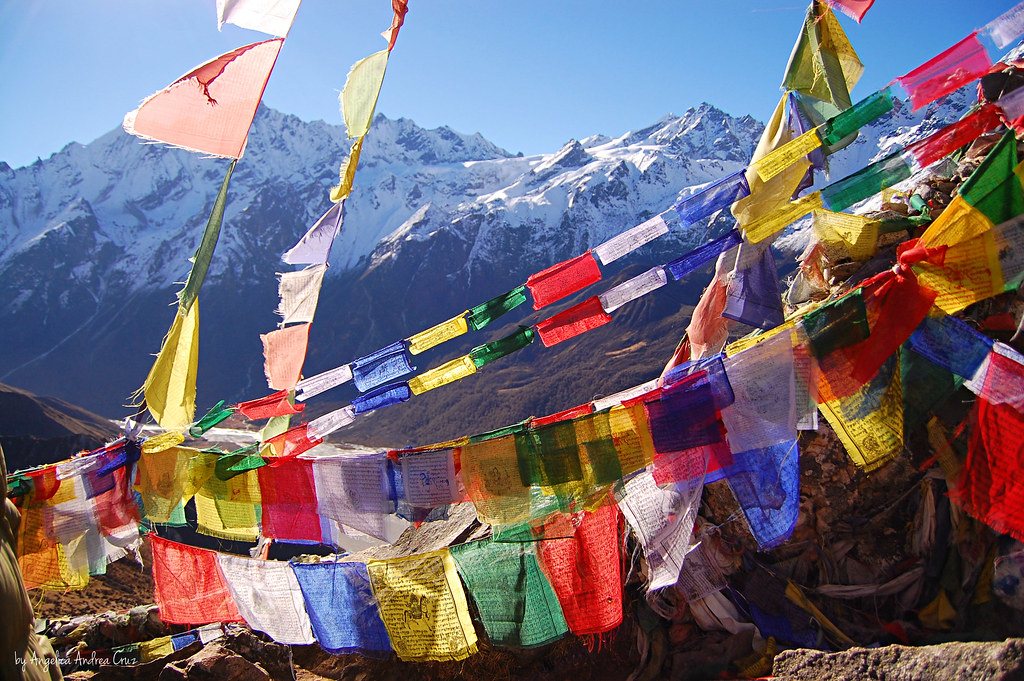
colorful Tibetan prayer flags
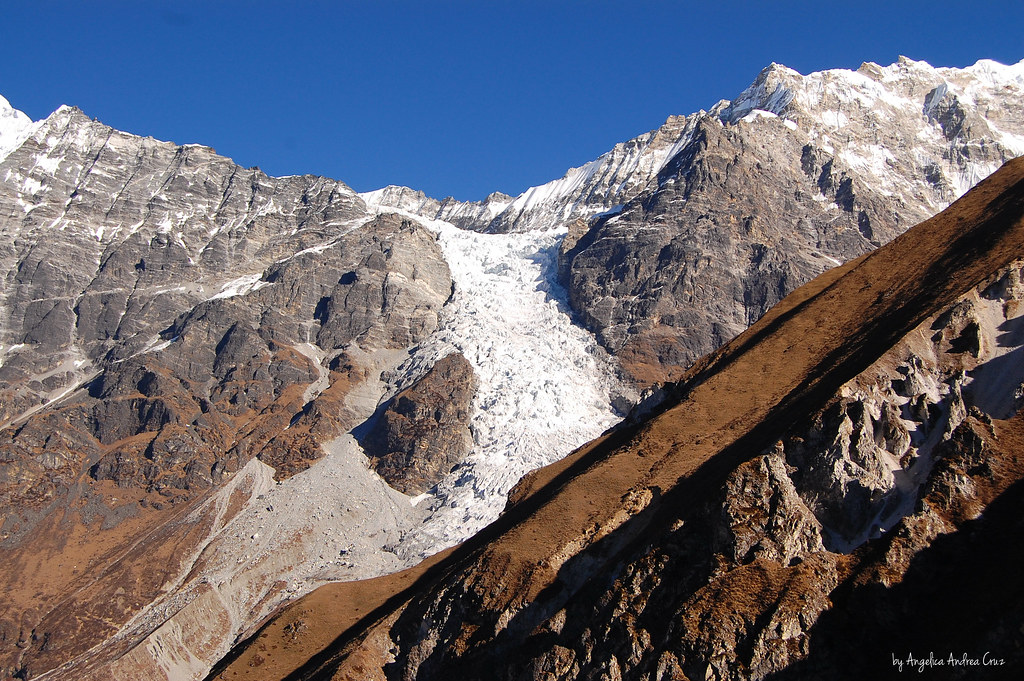
Langtang glacier
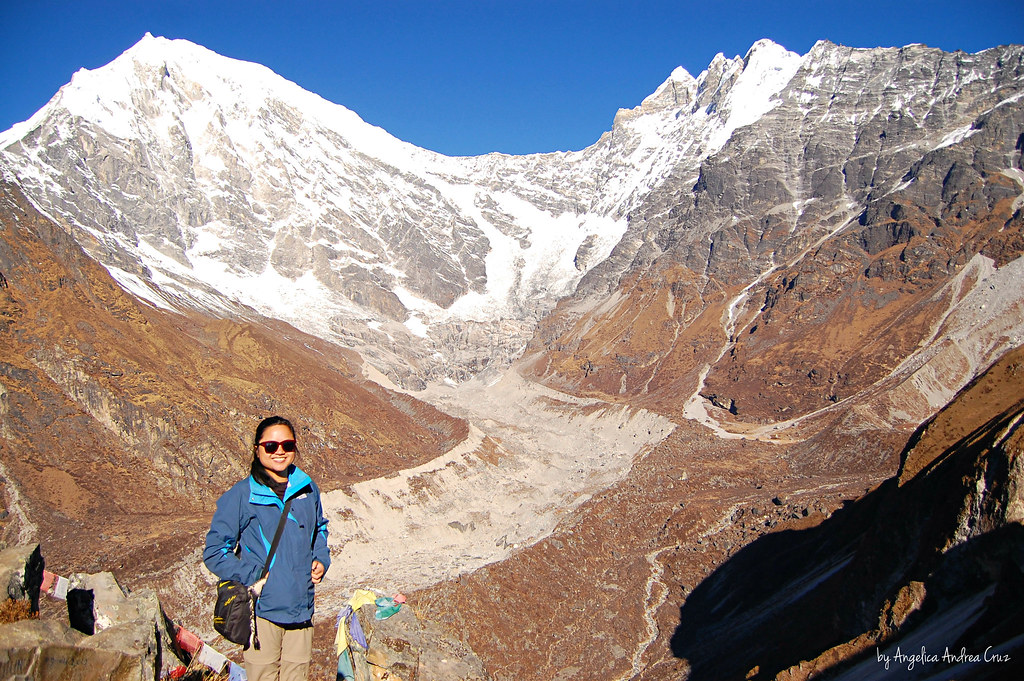
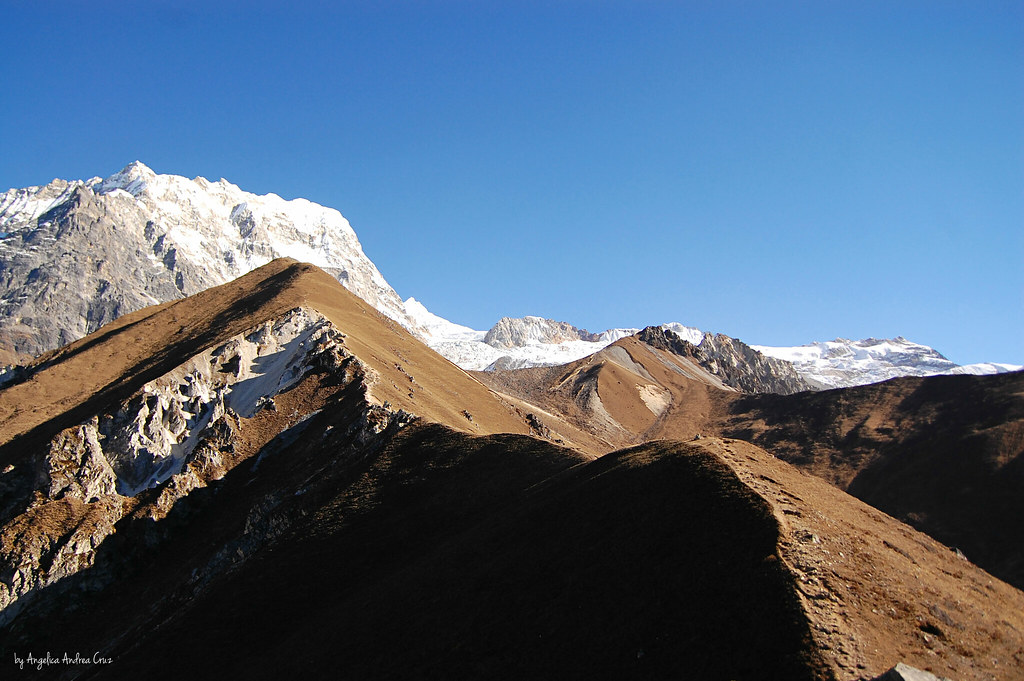 trail going closer to the Tibetan side of the Himalayas
the topmost part (not the snow-capped mountain) is apparently the real Kyanjing Ri peak (read on)
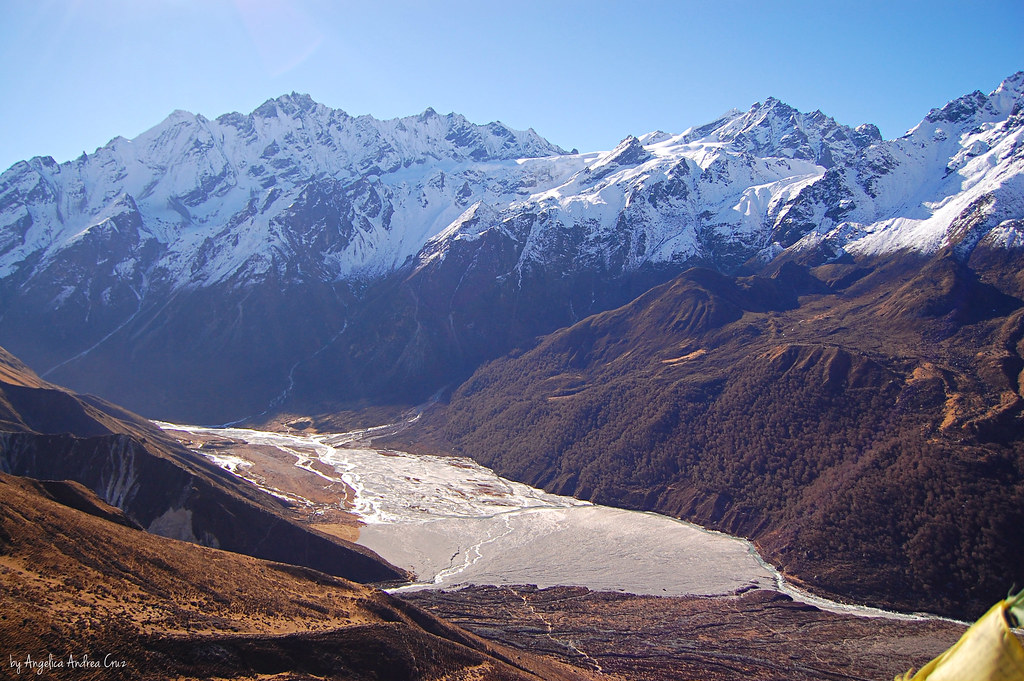 view from the top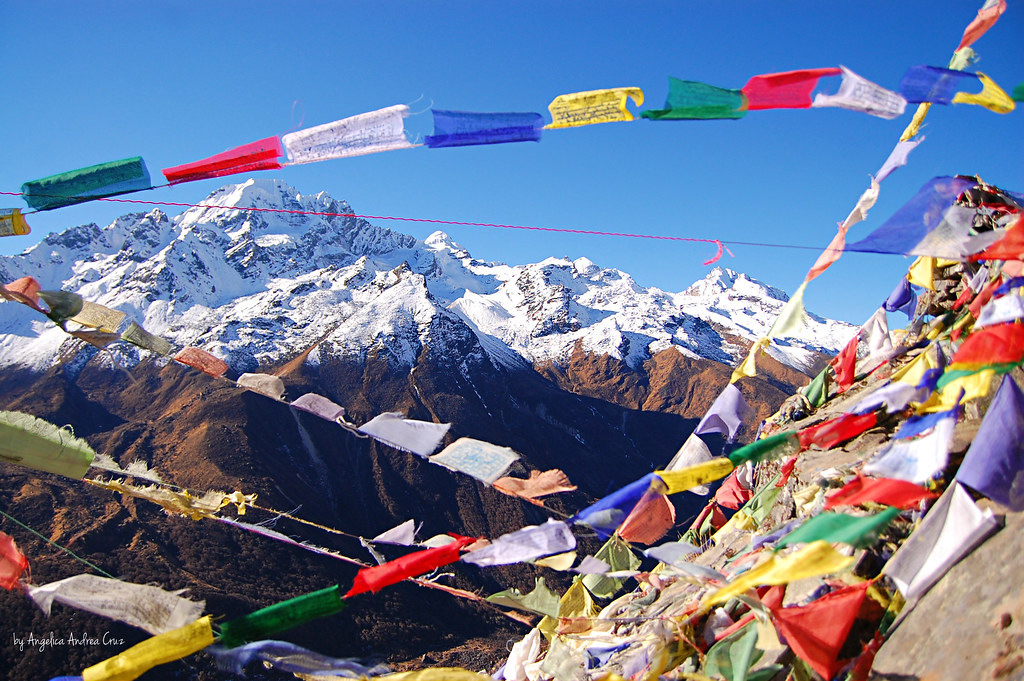
After taking photos and taking in the view, we started our descent. Even before the start of the trek and before going up Kyanjing Ri, I already told my guide that I’m more scared going down especially when the trail is slippery. And I was slowly beginning to feel a slight headache. So imagine how disappointed and pissed I was when during the start of our descent, my guide was rushing down. At one point, he waited for me and even teased me with “You look like an old woman when going down.” After finishing a third of the descent, I couldn’t see him anymore. The other guide was behind me and assisting the Dutch woman who was also taking her time to go down. Halfway through and I saw my guide at the foot of the mountain waiting for me. I didn’t care anymore if the other guide would hear me, or if other people would pass by. But I decided to let him know how I felt as soon as I reach the foot of the mountain.
 Kyanjing Gompa as seen from the top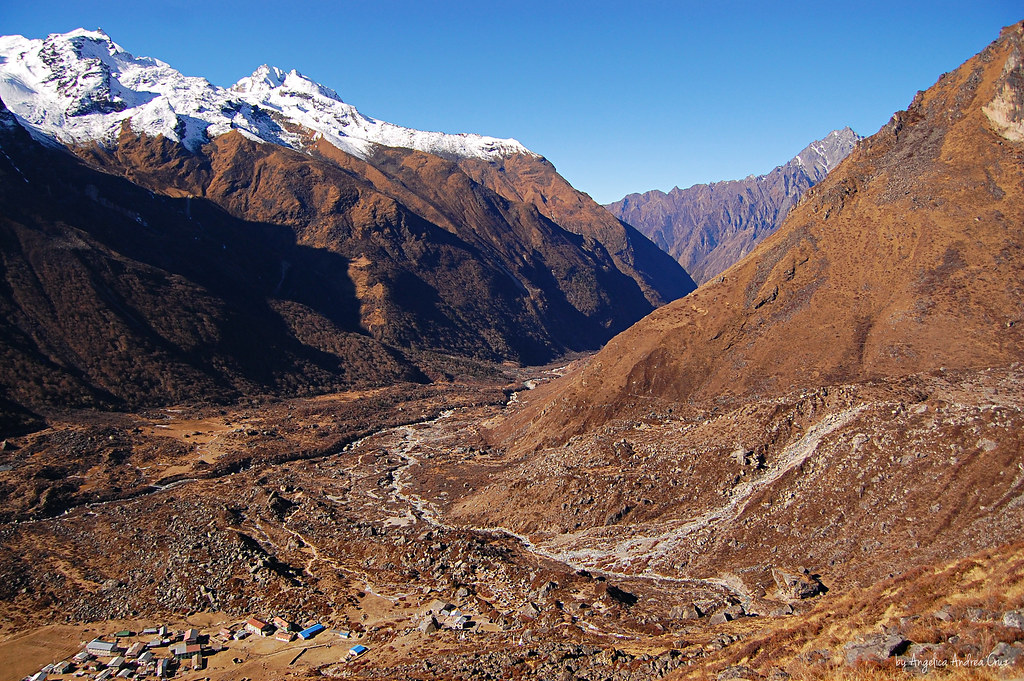
He’s a really nice guide and he’d always make sure I stay at a good hotel and that my food is served. But there were instances when he’d tell me how tired he was, how lonely he was, how excited he was to go back to Kathmandu, and that he “doesn’t think of being a guide as a job because he likes trekking and that he was just there helping his father, so I should treat him as a friend and a trekking buddy”. Which I did, I never complained when he was way ahead of me when we were trekking, when all the other guides we met were either right in front or at the back of their clients, or when he says that he’s very tired. Because I knew that guides should be treated better. But leaving me there during the riskiest part of the trek was very disappointing. I figured my safety was one of his reponsibilitirs as a guide. I told him as soon as I reached the foot of the mountain that the next time he should wait for me. He told me he had sore muscles, and that it was better for him to not stop walking. I told him that he should have told me this before leaving me up there on my own. He also said that he really didn’t leave me alone because there was another guide and the Dutch woman. I told him that he was my guide, and that the other one was busy attending to his own client. He said he was sorry and that he’d never do it again. Oh, but this wasn’t the only time he disappointed me. More on that later.
My headache worsened as I struggled to finish my lunch in Kyanjing Gompa. So I told my guide that I prefer to go down to Langtang and sleep there. Even without proper sleep and no proper food intake, I rushed going down. I felt like a drunk person keeping it together just to find a place to sleep in. A bar of Snickers was my only source of energy that time. After less than two hours, we made it to Langtang. We decided to stay in a teahouse with hot shower. This and a power nap made everything better. As we waited for the sunset, I saw the French guys going down. We were so happy to see each other and felt so proud that we all made it to the mountain peaks we wanted to climb. Too bad they couldn’t stay with us because their guide already made reservations in another hotel.
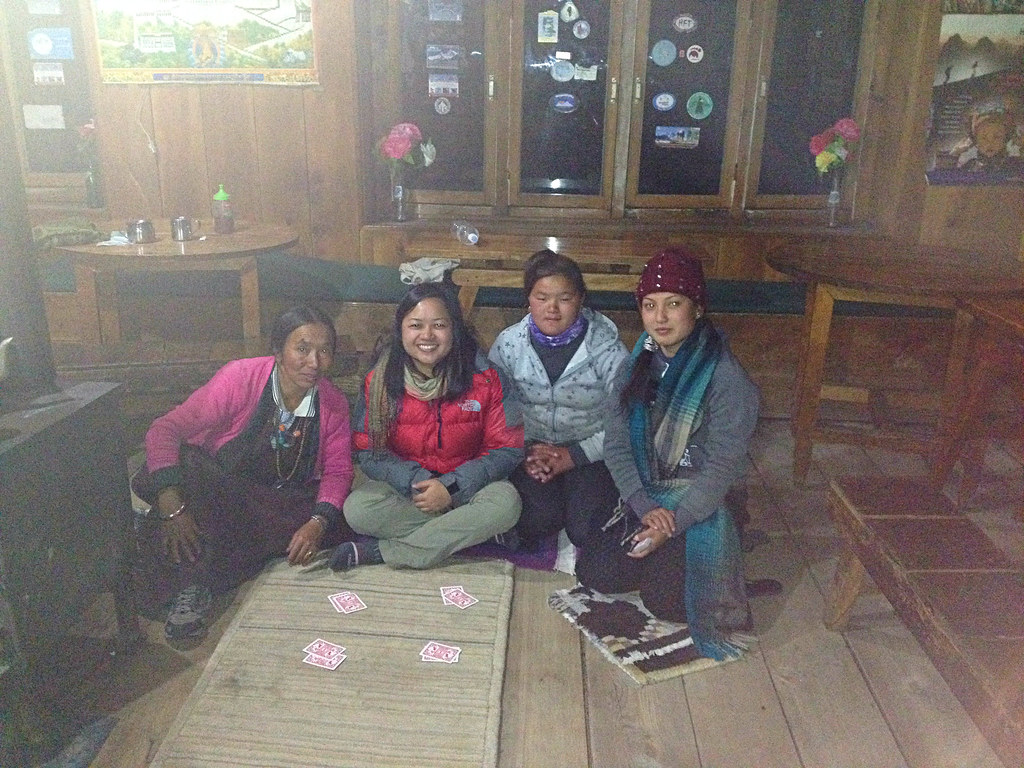
But we found new friends that night. The Tamang old woman working in the hotel invited us for post-dinner card games along with her cook and a nurse who worked at the clinic. It was so much fun, with the old woman being so competitive. My guide was always winning the game. So after some time, he told him that they have to exchange places. My guide didn't have a choice. But yes, she started winning after that. We were the only guests that night and it somehow felt like a home-stay experience.
Day 6 : Langtang to Syabrubesi
The winter cold was starting to take a toll on me. I had small wounds inside my nose that were starting to bleed, and I also thought that going back to Kathmandu as soon as possible would give me more time to go to Pokhara and do paragliding. I asked my guide if we can make it back to Syabrubesi in a day. Normally, it takes two days. He said that we could do it as long as I go down with the same pace I had the previous day. And I knew he wanted to go back to Kathmandu too.
We started the day early, stopping only for short water breaks. The French were also doing the same, since they wanted to spend more time in Kathmandu before leaving Nepal. The trek was relatively easy except for the streams with melted ice, the steep descents, and the mule traffic. At lunch, when our guides were inside, the French guys asked me how my guide was. He then asked me if my guide said that the peak I climbed was Kyanjing Ri and that it was at 4600 m. I told them yes. At first I thought they were just teasing me, because they really like doing it. But they said that their guide said that it wasn’t the peak, and that the other trail I saw (going to the Tibetan part of the Himalayas) lead to the right peak, and that it had better views. I felt a little bit disappointed because I knew I could have made it there, slowly, but I knew I could. I found out later on that they were right when I read my Lonely Planet guidebook.
I asked my guide about it after and he confirmed that it was the peak. But as soon as we left the French guys to start trekking, he apologized. He said that he was wrong and that sometimes guides can be wrong too with some information. I regret not reading my LP guide more thoroughly that time.
We walked for almost 7 hours to Syabrubesi. And it was beyond exhausting. But I was just relieved to know that I’ll be going back to Kathmandu and then to Pokhara, and I knew that I was going to be able to eat and sleep properly after the trek. This is no joke, but I lost 3 kilos just from that 7-day trek. Normally, I’d be happy with a weight loss that quick. But I was just really hungry after that trek, and realized how lucky I am to be living in a tropical sea-level country conducive to proper eating and good sleep. haha
*Back in Kathmandu, Nitti of Hotel Red Planet asked me about my experience. I told everything was okay until that time when we were going down Kyanjing Ri. They apologized for what happened, and wanted to get more details about it since they recommended the company to me. This I really appreciated. I heard after that they called the company and talked to them about it.

It was my second trek in Nepal and this time it offered a different landscape and a glimpse of another culture different from the Annapurnas. I know now that I’ll be going back to Nepal again in a few years and probably do a trek in the more remote regions of the Himalayas, or maybe cross a pass the next time around. It’s only the start of my Himalayan adventures in Nepal :)
-----------------------------------------------------------------------------------------------
FEW POINTERS ON HIRING A GUIDE
After my experience, I honestly still prefer independent trekking if the region doesn’t require a guide. Or maybe it was just my guide and also my personality – I prefer to travel with people who are low-maintenance and who don’t mind riding public buses, and those that are strong-willed enough to push me physically because they know a great reward awaits. My guide wasn’t like that at all, he preferred riding a private car going back to Kathmandu and getting his own room with a hot shower, despite the fact that I kept on telling him that I don't mind riding the bus and sleeping in cheaper hotels. But I was really disappointed that we didn’t push it to the real Kyanjing Ri Peak. And I think we could have tried to climb Tsergo Ri, we could have at least tried.
But I met other guides who seemed more responsible. The guide of the Spaniard (he was an independent guide and he spoke Spanish fluently) was fun but he knew when it’s time to act as a guide. I never saw him in front of his client, even though I’m pretty sure he can walk a lot faster. He encourages his client in climbing the peaks, even me actually. They invited me to go up Kyanjing Ri for sunset, but I couldn’t because my guide was nowhere in sight.
So here are some pointers to consider when hiring a guide and when trekking with a guide, that I know I will remember next time.
Research on the trek/region you have in mind. Even before looking for a trekking company/guide, research well on the trek you want to do. Prepare your own itinerary, an itinerary you’d be comfortable with. Research on the average daily cost of trekking in those regions, so you’d have a range in mind. Research on the possible side trips you can do.
Sit down with your guide before hiring him/her. Invite them for coffee/lunch before hiring them. Ask them about the trek – how many days and what you can see and do during the trek, and the culture of the people you’ll encounter. Ask if they have photos of the previous treks they’ve done. From the meeting, you can also assess if they’re okay to trek with. If he is an independent guide, ask for his government license, and ask if he has his own insurance and if not, how much it would cost.
Hire an older guide. I honestly think that an older guide, somewhere in the range of 30s and up would be better, experience is very important.
Be friendly but remember that it is still a guide-client relationship. Be friendly with your guide, and enjoy the whole trek with them. But not too comfortable that they forget that they’re still there as your guide.
*Back in Kathmandu, Nitti of Hotel Red Planet asked me about my experience. I told everything was okay until that time when we were going down Kyanjing Ri. They apologized for what happened, and wanted to get more details about it since they were the one who recommended the company to me. I heard after that they called the company and talked to them about it.
Posted on : January 3, 2014
--------------------------------------------------------------
NEW BLOG!
Hey everyone! I'm moving to a new blog address : www.angelicacruzph.com
Same content but with some changes in design and layout. I'll still be keeping this one but will begin posting new stuff in the new blog. See you there!
You can still find me at the following:
Email : anggetravels.blog@gmail.com

 rss
rss twitter
 pinterest
 facebook


No comments:
Post a Comment